Special Guests > Gidding: Nicholas Nickleby Review
Nicholas Nickleby Film Review [1]
Nicholas Nickleby, written and directed by Douglas McGrath
Review by Robert Giddings
School of Media Arts and Communication, Bournemouth UniversityReprinted with the kind permission of the author
Published on this site April 15, 2004
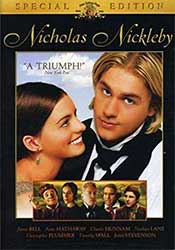
Nicholas Nickleby (2002) Starring Charlie Hunnam, Anne Hathaway, Jamie Bell, and Christopher Plummer
…All that
had given 'Pickwick' its vast popularity, the overflowing mirth, hearty
exuberance of humour, and genial kindliness of satire, had here the advantage
of a better laid design, more connected incidents, and greater precision of
character. Everybody seemed immediately to know the Nickleby family as well as
his own. Dotheboys…became a household word. Successive groups of Mantalinis,
Kenwigses, Crummles, introduced each its little world of reality, lighted up
everywhere with truth and life…From first to last they were never for a moment
alien to either the sympathies or the understanding of any class; and there
were crowds of people at this time that could not have told you what imagination
meant, who were not adding month by month to their limited stores the boundless
gains of imagination”. [2]
Now a major motion picture”. Ah yes. So it is.
There was a ticket offer in the Radio Times. In the UK, the Pastimes
retail chain ran a lavish promotion. Then came the film tie-in paperback with
top-hated young Charlie Hunnam on the cover. Boz rides again. And again. In the
USA, (though not, as yet, in the UK) readers can enjoy the new Penguin
American edition” of Nicholas Nickleby edited by Douglas MacGrath
who (by a coincidence into which it would be just too, too tedious to explore)
also directed the film. They seem to be making quite a splash with this film.
It was a very important book, too, in its day.
Nicholas Nickleby 1839 was a very popular novel, regularly
selling 50,000 copies of its monthly installments and bringing a profit of
£14,000.[3]
The
serialization of Pickwick Papers over eighteen months from March 1836
was a triumph previously unknown in literature, with sales topping 40,00 a month
at its height. Serialization, with advertisements in the parts, was rapidly to
become standard. Pickwick Papers showed what could be done. Advertising
as an element of the mass media was well on the way. Chapman and Hall decided
to publish the book cloth bound in volume form after its serial run in 1837.
This conferred the status of literature on Pickwick Papers and set it
apart from ephemeral periodic journalism.
This was a landmark in the history of attractive, quality book
publishing. Its success at home and abroad was previously unknown in
literature. Dickens commented, "My
friends told me it was a low, cheap form of publication, by which I should ruin
all my rising hopes, and how right my friends turned out to be, everybody
knows".
Publishers underwrote serial publishing costs with
advertising revenue. A good long story was needed to build up readership
loyalty. A successful author was
therefore a desirable commodity. Publishers wanted success repeated. We are not
far from the world of commercial TV and Harry Potter publishing. Dickens’s
genius lay in his capacity to combine commercial potential with artistic
integrity. He was gifted with invention that never
dried up. It’s hard to credit, yet he was writing Oliver Twist at the
same time as Pickwick Papers. He finished this in October 1837 and Oliver
Twist completed in March 1839. He then signed the contract for Nicholas
Nickleby 19 November 1837. The new novel was serialized in twenty monthly
parts from March 1838 to October 1839. Public appetite for Nicholas Nickleby was
aroused by skillful publicity and it sold an unprecedented 50,000 copies each
month when first serialized. As Sylvere Monod commented, Nicholas
Nickleby was the supreme and striking confirmation of the triumph of Pickwick
Papers[4].
Dickens played a major role in constructing the novel” in our culture.
And, by the way, in January 1839 he was already working on Barnaby Rudge.
It’s
often claimed that much of his work is rambling as a result of its being
written for serial publication with the printer’s boy waiting at his elbow as
he scribbles away. But he owes much to his deep immersion in 18th
century English fiction, especially Smollett and Fielding. The picaresque
life-and-adventures form suited Dickens’s imagination. He could have his hero
and a companion travel around, involved in various adventures -- Pickwick/Sam
Weller; Nicholas/Smike; Martin Chuzzlewit/MarkTapley -- and have the combining
narrative held loosely on a thread gathered together at the conclusion. This is
certainly the shape of Nicholas Nickleby.
The plot is fairly sprawling but rich in characters
and incidents, with plenty of those anticipated Dickensian ingredients –
melodrama, pathos and comedy. Nicholas and Kate are
thrown penniless into life on their father’s death. Scatter-brained Mrs
Nickleby seeks help from her late husband's brother, wicked uncle Ralph. Ralph
gets Nicholas a teaching job at the dreadful Dotheboys Hall, Yorkshire and is
apprentices Kate with Mrs Mantalini, a milliner. Nicholas is appalled at the
cruelties of Squeers and thrashes him when he beats Smike, a poor drudge of a
pupil, for running away. Nicholas then flees to London, taking the unfortunate
Smike with whom he has many colourful adventures. Kate suffers the insulting
advances of Mrs Mantalini's affected husband and Ralph’s aristocratic
associates.
After numerous
other adventures, it all works out well. He falls in love with Madeline Bray,
daughter of one of Ralph’s victims. Ralph plans to marry Madeline off to Arthur
Gride, who intends to diddle Madeline out of her property. Ralph villainies are
exposed, including the fact that he’s Smike’s father, who unfortunately dies,
telling Nicholas on his deathbed of his everlasting love for Kate Nickleby. Ralph hangs himself. Nicholas marries
Madeline. Kate marries the nephew of Nicholas’s philanthropic employers, the
Cheeryble brothers.
We are used to
radio, film and TV dramatizations of the classics, the media’s continuation of
literature (to recycle that phrase of General Klaus von Clausewitz), by other
means. And Dickens’s fiction, I dare say, has always yielded useful fodder for
stage and screen. It wasn’t just Dickens. The Victorians indeed were well used
to stage versions of novels of the day, not only East Lynne, (based on
the novel by Mrs Henry Wood, subsequently filmed seventeen times and twice
televised); Lily of Killarney (stunning melodrama by Dion Boucicault,
based on Gerald Griffin’s novel The Collegians, also provided libretto
of celebrated Victorian opera by Benedict) and Lady Audley’s Secret
(based on the novel by Mary Elizabeth Bradden, interestingly dramatized for
television two years ago) but more serious books as well. And this was not all.
There was a long
standing British tradition of dramatizing novels that in due course had
dutifully (and profitably) recycled Defoe, Fielding, Goldsmith, Smollett,
Richardson and Sir Walter Scott. (Who in due course provided almost as much
material for operatic libretti as Shakespeare). Even such a rambling work as
Pierce Egan’s Life in London made it to the boards. Ransacking Dickens
for suitable stuff has a very long tradition stretching right back to the
production at the Adelphi Theatre in October 1834 of A Bloomsbury
Christening in a version for the stage by the novelist’s friend, John
Baldwin Buckstone. Stage versions of Pickwick Papers, Oliver Twist and Nicholas
Nickleby duly followed and writers such as Buckstone, W. T. Moncrieff and
Edward Stirling continued to dramatize his fiction. Not only did the novels
provide an abundance of comic and melodramatic incident, but rich parts for
actors to get their teeth into. W. J. Hammond was for a time the Sam
Weller, and Mrs Keeley delivered pathos in generous measure as Oliver, Smike,
Little Nell and Barnaby Rudge. Dickens was sometimes a willing collaborator.
The novelist’s feelings about all this were ambivalent. He was in part thrilled
that early staging bestowed instant popularity on his work, but on the other
hand as dramatizations frequently went on before serialization was completed,
there was the danger of giving the plots away.
By 1850, with his
reputation and fame well established, there had been an estimated 240 stage
versions of his fiction. Interestingly enough, 25% of these were versions of Nicholas
Nickleby.
Dickens attracted
filmmakers from the very beginning.
Dotheboys Hall was the first bit of Boz put on the silver screen in
1903.[5]
Nicholas Nickleby was filmed again in 1916.[6]
Alberto Cavalcanti made a brave attempt in 1947 and managed to retain quite a
lot of the novel’s ingredients, but somehow the vitality of the novel
evaporated in the process. [7]
A great deal of
nonsense has been written about the suitability, nay the inevitability of
Dickens and film. The fact that so many of his novels have been filmed proves
nothing. Arithmetic has but modest value in aesthetics. To argue that Dickens’s
suitability for film is demonstrated by the fact that so many of his fictions
have been filmed is like arguing Haydn is a greater symphonist than Beethoven
because he composed 104 symphonies against Beethoven’s humble nine.[8] I think Dickens provides several ingredients
basic to popular cinema -- striking characters, melodrama and a warm and human
moral vision. But a very considerable about is of the real Dickens gets lost in
translation from page to big screen. This version of Nicholas Nickleby
demonstrates this rather well.
The plot of Nicholas
Nickleby may seem a muddle but it’s packed with vitality and riotous
observation. It survives to excite generations of readers. Even though much of
its contemporary relevance is lost today, Nicholas Nickleby obviously tempted
film makers from the very beginning, has several times been serialized on
British television[9] and
brilliantly dramatized for the stage by David Edgar for the Royal Shakespeare
Company in 1982[10]. He was
already well-established playwright and had previously dramatized books for the
stage (Mary Barnes and The Jail Diary of Albie Sachs) when Trevor
Nunn, artistic director of the Royal Shakespeare Company, asked him to make a
stage version of Dickens novel:
…and the
choice was already down to two: ‘Our Mutual Friend’ and ‘Nickleby’…The extent
of my Dickensian scholarship can be judged from the fact that my first question
was ‘Is ‘Nicholas Nickleby’ the one with Mrs Gamp in it”.[11]
This version of Nickleby
is nevertheless one of the most vigorous and convincingly Dickensian”
versions of a Dickens novel ever made.
The playwright has
described how this extraordinary production was collectively worked up with the
whole company in research, discussion, experiment, exercises and workshops.
This process led to their increased awareness of the organic wholeness of Nicholas
Nickleby despite its apparent rambling structure. No element could be
deleted without damaging the work’s intentions. They realized that even the
Kenwigs could be sacrificed as this plot encapsulated, in comic form, the
obsession of the whole”.[12] They realized that beneath the Dickensian”
surface level was a rich portrait of a society very like our own, in which
rapid technical and economic change had created considerable economic
opportunity for some along with social upheaval, considerable hardship,
insecurity and doubt. In the process David Edgar’s team realized that to do
justice to the novel, they would need the space of a two evening production. [13] And once again a major filmmaker has been
drawn to this novel.
Douglas McGrath,
who was responsible for the excessively pretty version of Jane Austen’s Emma,
has now written and directed Nicholas Nickleby. Emma contained
little evidence that he might have a sure touch for early Dickens. And indeed
he hasn’t.
Dickens’s fiction
offers splendid opportunities to the film industry. His work has a universal
appeal and consequently a certain attraction to potential audiences on both
sides of the Atlantic as well as elsewhere. His novels are not just classics”
and therefore educationally OK, but they’re seen as wholesome” and
improving and consequently good for family viewing. Plenty of action. Plenty of
parts for character actors. And in casting, it will certainly be possible to
use American stars as well as British thespians. The heritage industry makes
Dickens films easy to market. In this respect, it was interesting to note the
special promotion of Nicholas Nickleby in the British retail chain Pastimes.
There are opportunities for video, DVD, book tie-in as well as additional
merchandize. And yet there are severe problems to be met and dealt with. The
two most obvious concern the long, complex and elaborated nature of Dickens’s
novels and the question of style.
Plot and
Story.
Filming or
televising Dickens imposes considerable time restrictions. Dickens’s fiction
was serialized over weeks or months. Most of the major novels in monthly
episodes over eighteen months. The results are novels of considerable length,
and the story often elaborated with various interlocking plot lines. Even
serializing such novels for broadcasting will only result in five hours or so
of radio or television drama. A film for cinema release may last two or more
hours at the most. Consequently pruning cannot be avoided. But what can be cut?
There has to be a firm understanding of necessary story outline (how can we
make this story coherently work within the time we have?) and a firm grasp of
the plot, i.e. what the novel is about, its leading themes and preoccupations,
what Dickens is trying to tell you. Can whole and entire episodes be omitted
without damage to the effect of the whole? Can we, without too much of a sense
of loss, cut out whole characters? Or merely cut down the part they play?[14]
To accommodate Nicholas
Nickleby to the big screen Douglas McGrath has quite ruthlessly dealt with
the novel and mangled the plot quite seriously. Only the barest outline of the
classic Smollett picaresque storyline remains. Uncle Ralph’s willingness to
prostitute his niece by sending her to milliner Mrs Mantalini goes for nothing
(we do not even have Mr or Mrs Mantalini, so the pair of ‘em must have gone ‘to
the damnation wows-wows’). There’s no Kenwigs. No Mr Lillyvick, so no
romance with Miss Petowker. Mrs Nickleby’s admiring lunatic vegetable-throwing
neighbour has been erased. There’s no Tim Linkinwater, the Cheerybles fat and
loyal clerk, an obvious analogy to Ralph Nickleby/Newman Noggs. There’s no use
of Squeers using Peg Sliderskew (A short, thin, weasen, blear-eyed old
woman, palsy stricken and hideously ugly”) to spy on Gride, so we lose the
magnificent operation by Frank Cheeryble and Noggs, who intercept these
machination. The plot to marry off
Nicholas’s love, Madeline Bray, has been butchered. This I think is a serious
loss as it considerably adds to our knowledge of Ralph Nickleby’s villainies.
Her father, Walter Bray, who is a selfish, misanthropic and bankrupt widower,
treats Madeline as a slave. Walter Bray is seriously indebted to Arthur Gride
and Ralph Nickleby. Ralph’s plot is that Madeline should marry Gride (who is
about seventy) and that this should cancel Walter Bray’s debt. Peg Sliderskew
discovers various documents that detail Gride’s control over various people. By
marrying Madeline he had hoped to come into a fortune from Bray. In the novel,
Walter Bray dies and Madeline is thus saved from having to marry Gride. Arthur
Gride is later murdered by burglars. All this falls disappears in the film
version. And so on[15].
Well, what have we left? The omission of quite
considerable sections of the plot is not the only loss in this film. The
characterisation in this novel is probably not all that rich, deep, subtle or
convincing. This was subject to early comment. An
anonymous contemporary review expresses this well:
.... The hero
himself has no character at all, being but the walking thread-paper to convey
the various threads of the story. Kate is no better; and the best-drawn
characters in the book, Mr Mantalini and Mrs Nickleby, have only caricature
parts to play; and in preserving them, thee is no great difficulty... Squeers
and Ralph Nickleby become worse and worse as the story proceeds... Squeers at
first is nothing more than an ignorant and wretched hound, making a livelihood
for himself and his family by starving a miserable group of boys. The man has
not the intellect for any thing better or worse; and yet we find at last an
adept in disguising himself, in ferreting out hidden documents, in carrying
through a difficult and entangled scheme of villainy. Ralph Nickleby makes his
appearance as a shrewd, selfish, hard-hearted usurer, intention nothing but
making and hoarding money; in the end we find him actuated by some silly
feelings of spite or revenge, by which he cannot.... make a farthing.... His
committing suicide, and that out of remorse too, is perfectly out of
character... (he) has not done anything that could expose him to legal
inconvenience..." [16]
This might not have an insurmountable problem in
filming this novel. In fact, vivid caricature works well in film. In what might
have been the leading roles of Nicholas (Charlie Hunnam) and Kate (Romola
Garai) are adequate. Charlie Hunnam is rather too young for this role
(Dickens’s Nicholas is manly and well-formed”) and does not mature as
the story unfolds. He looks uncomfortable to find himself top hated and in the
19th century when he would clearly be more at home on a beach in
California. I could not believe this pop star looking young fellow had it in
him to take it upon himself to thrash the tyrannical Squeers. We are not given
much to go on in the novel as we are told little more than that Kate is a
slight but very beautiful girl of about seventeen” but even so, I felt she was
a bit more of a mature young miss.
Mrs Nickleby (Stella Gonet) is not given much to go
on. The original’s rhapsodic dottiness has gone: ” I had a cold once...I think it was in the year eighteen hundred and
seventeen; let me see, four and five are nine, and -- yes, eighteen hundred and
seventeen, that I thought I never should get rid of ... I was only cured at
last by a remedy that I don't know whether you ever happened to hear of.... You
have a gallon of water as hot as you can possibly bear it, with a pound of salt
and sixpenn'orth of the finest bran, and sit with your head in it for twenty
minutes every night just before going to bed; at least, I don't mean your head
-- your feet. It's a most extraordinary cure. I used it for the first time, I
recollect, the day after Christmas Day, and by the middle of April following
the cold was gone. It seems quite a miracle when you come to think of it, for I
had it ever since the beginning of September...”
Ralph (Christopher
Plummer) is really the central character, who holds all the elaborated threads
together. He is the star of the show rather than the eponymous hero. Plummer
manages to suggest that something in the wrinkles of his face and his cold
restless eye, which seemed to tell of cunning that would announce itself in
spite of him”. McGrath occasionally works into Ralph’s dialogue parts of
Dickens’s authorial comment to good effect: Speculation is a round game;
the players see little or nothing of their cards at first starting; gains may be
great – and so may losses. The run of the luck went against Mr Nickleby; a
mania prevailed, a bubble burst, four stockbrokers took villa residences at
Florence, four hundred nobodies were ruined….” For reasons never explained
in the film, Ralph seems to live and work in a natural history museum. Never
mind, he is old fossil, well suited to the company of dehydrated reptiles. It
is great performance and the silky, sinister voice is a masterstroke.
Newman Noggs’s
role suffers considerable reduction in this version, but Tom Courtenay manages
the best he can with what he has left. He strives to look the part. He’s
slightly dotty, but by no means the raving ex-alcoholic eccentric that Dickens
painted him: A tall man of middle age, with two goggle eyes, were of one
was one was a fixture, a rubicund nose, a cadaverous face, and a suit of
clothes…. Much the worse for wear, very much too small, and placed upon such a
short allowance of buttons that it was marvellous how he contrived to keep them
on”.
We get the sense
that Noggs is very well aware of what Ralph is up to and comically raises his
fists to him from a position of safety, but much of this vital character has
been surgically removed, not without considerable loss. He has an interesting
back story as a former well-to-do gentleman who was almost certainly ruined by
Ralph, who himself offers this biographical explanation to Mr Bonney, a fellow
swindler:
…Newman Noggs
kept his horses and hounds once…and not many years ago either; but he
squandered his money, invested it anyhow, borrowed at interest, and in short
made first a thorough fool of himself, and then a beggar. He took to drinking,
and had a touch of paralysis, and then came here to borrow a pound, as in his
better days I had – had…done business with him. I couldn’t lend it, you
know…But as I wanted a clerk just then, to open the door and so forth, I took
him out of charity, and he has remained with me ever since. He is a little mad,
I think…but he is useful enough, poor creature – useful enough”.
This is obviously
a highly sanitized account of the businesslike manner in which Ralph had
fleeced Noggs in days gone by, and it would explain Noggs’s motivation for
patiently working on Ralph Nickleby’s downfall.[17]
Yet there are genuinely warm and benevolent aspects to Newman Noggs. It’s Noggs
who finds Nicholas employment with as tutor to the Kenwigs family when he comes
back to London after his adventures in Yorkshire alienate him from Ralph. It is
Noggs who warns Nicholas about the danger Kate Nickleby faces from Sir Mulberry
Hawk, while Ralph fails to protect her and Mrs Nickleby is so silly as to
flattered by Hawk’s attentions. When Ralph uses Squeers to spy on Gride and to
recover documents that may reveal dark and damaging secrets, it is Newman Noggs
(helped by Frank Cheeryble) who scupper these proceedings. In the novel we are
given the impression that Noggs’s opposition gradually mounts towards its final
climax, and does not come as a bolt from the blue, as Noggs picks up a very
deal of what transpires between Ralph and Squeers before Ralph dispatches him
about other duties. In fact, Noggs’s interference is violent and direct, as he
fells Squeers to the floor with a pair of bellows at the moment of the
schoolmaster’s supposed triumph in securing the papers he was instructed to
find. (Nicholas Nickleby, Chapters 58). At the moment of the unmasking
of Ralph, Noggs reveals the extent of his association with him:
When did I
ever cringe and fawn to you – eh? Tell me that1 I served you faithfully. I did
more work because I was poor … I served you because I was proud … and there
were no other drudges to see my degradation, and because nobody knew better
than you that I was a ruined man, and that I hadn’t always been what I am, and
that I might have been better off if I hadn’t been a fool and fallen into the
hands of you and others who were knaves…” (Nicholas Nickleby,
Chapter 59).
Squeers plays a
big part in this novel and his role is boldly tackled by Jim Broadbent. He very
nearly brings it off. Broadbent’s great strengths lie in realizing the enormous
comic potential in every day, humdrum characters, rather than larger-than-life
melodramatic villains and grotesques. He certainly does well with the comic
grotesquery of the role but fails to dig into the fiendish barbarity of the
man. However, when on stage (as it were) with his wife, Juliet Stevenson, a
wonderful enchantment takes over. They are superb together. Hilariously,
outrageously funny (Where’s my Squeery!” and their marriage
relationship is a very interesting and, as I’d guess, a fairly fulfilling one.
Smike is one of
the most difficult roles in Dickens successfully to realize in stage or screen.
There are two major difficulties to surmount. One is convincingly to portray
the terrible physical and emotional damage inflicted upon him by his parentage
and the treatment he has endured from Squeers without resorting to an
assortment of psychological and physical symptoms. The second is resisting the
tendency simply to over play the pathos of the role. Smike must remain, beneath
all the clinical apparatus, real, genuine human being, with a brave and
generous heart.
This highlights a
considerable problem in handling Dickens’s work. We know so much about him, and
have been so influenced by the not-altogether beneficial application of
off-the-peg Freudianism that critics all too frequently deploy, that our
perceptions of the character are distorted by bringing in far too much of
Dickens’s own history. It’s all very well to recall ad nauseam that the
young Dickens endured the ordeal of the blacking factory and felt his parents
had abandoned him[18]
but we have to concentrate in recreating Smike so that the character achieves
the right impact and effect upon the audience. Smike is about eighteen or
nineteen years old, and tall for his age, wearing clothes that are too small
for him, that nevertheless fit his attenuated frame. His appearance is so
strange, freakish and bizarre that when Nicholas first notices him he could
hardly bear to watch him”. Jamie Bell brings off a very difficult task here
in combining the right amount of pathos and awkwardness while yet making Smike
believable and indeed likable. It is well-graded performance, too, as much is
held in reserve for the final horrific revelation about the way Ralph treated
him as a child. The friendship between Nicholas and Smike is well established
and seems quite understandable.
Vincent Crummles
(Nathan Lane) is very well played for all he is worth. At first sight I
thought, no, this is just not going to be right. Crummles needs biggish man,
somebody on the lines of Francis de Wolff, Francis L. Sullivan or Donald
Wolfitt. But such was his sense of the histrionic that after a moment his
stature seemed to grow. Nor did this performance descend to mannerism, that so
easily could have been the case: …the face of Mr Crummles was quite
proportionate in size to his body … he had a very full under-lip, a hoarse
voice, as though he were in the habit of shouting very much, and very short
black hair, shaved off nearly to the crown of his head … to admit … of his more
easily wearing character wigs of any shape or pattern … He was very talkative
and communicative, stimulated perhaps, not only by his natural disposition, but
by the spirits and water he sipped very plentifully, or the snuff he took in
large quantities from a piece of whitey-brown paper in his waistcoat pocket”.
(Nicholas Nickleby, Chapter 22).
Mrs Crummles
(Barry Humphries) has a minor part in proceedings, but here makes a
considerable meal of it in a manner likely to give ham a bad name. Far too much
time and space is given to Highland Fling dancing Mr Folair (Alan Cumming)
who, far from remaining the shabby gentleman in an old pair of buff
slippers” is allowed to become the star of the show and far to indulge his
tartan choreographical dexterities even unto tedium.
Sir Mulberry Hawk
(Edward Fox) is here a somewhat older man-about-town than might have been
expected. This makes his all-too-obvious intentions on teenager Kate Nickleby
even sleazier. He appears an old roué, rather than a Byronic scoundrel. There’s
more of Don Pasquale here than Don Giovanni. Dickens describes Hawk as the head
of his profession in ruining young gentlemen and maintaining his ascendancy
over them: …and to exercise his vivacity upon them, openly, and without
reserve. Thus, he made them butts, in a double sense, and while he emptied them
with great address, caused them to ring with sundry well-administered taps, for
the diversion of society”. This aspect of Hawk is finely done and the
tensions between Hawk and Lord Verisopht (Nicholas Rowe) mount to quite a
crescendo.
The Cheeryble
twins (Timothy Spall and Gerard Horan) are quite magnificent. And more to the
point, they are actually convincing. This is quite an achievement, as they seem
an unlikely pair of generous philanthropists. Nevertheless, Dickens based them
on real people, whom he met through his friendship with Harrison Ainsworth.[19]
Charles Cheeryble is described as: A sturdy old fellow in a broad-skirted
blue coat, made pretty large, to fit easily, and with no particular waist; his
bulky legs clothed in drab breeches and high gaiters, and his head protected by
a low-crowned broad-brimmed white hat, such as wealthy grazier might wear…”
And Edwin, his twin brother was: Something stouter than his brother; this,
and a slight additional shade of clumsiness in his gait and stature, formed the
only perceptible difference between them”. Thus the novelist immortalised
William and Daniel Grant, who were, by the time Dickens met them, very rich
merchants, though they were formerly graziers, from Elchies, in Scotland. (Note
the grazier’s hat worn by Charles). They’d failed as shopkeepers, but went on
to deal in wool and linen in Manchester, where they thrived. A Liverpool merchant
came to them for help during a crisis and was unconditionally given £10,000. [20]They
were in real life as staggeringly generous as Dickens recounts. It would be
insidious to praise one performance above the other, as these two twins are a
delightful turn, but it seems to me Timothy Spall has a natural touch in
playing Dickens.
The loss of Alfred
Mantalini partnership is a shame. Mr Mantalini, wastrel, womaniser and
pretentious layabout, is one of Dickens’s most frolicsome naughty characters.
His name was really Muntle but it was considered an Italian name over the door
would do the business good and Mantalini he duly became. Much else besides was
false: He had married on his whiskers; upon which property he had previously
subsisted, in a genteel manner, for some years; and which he had recently
improved, after patient cultivation, by the addition of a moustache, which
promised to secure him an easy independence: his share in the labours of the
business being at present confined to spending the money”. He labours to
considerable success, eventually bankrupting his wife. The loss of the splendid
Mantalini dialogue is to be lamented. Think what a pair of quality actors would
have done with it! Take the scene at breakfast time where Alfred, having been caught
philandering, is enduring his wife’s understandable displeasure. If you will be odiously, demnebly
outrageously jealous, my soul, you will be very miserable – horrid miserable –
demnition miserable”. There is then
the sound as if he was sipping his coffee. I am miserable,” she answers. Then you are an ungrateful, unworthy, demnd
unthankful little fairy” Mantalini answers. This she denies. Do not put yourself out of humour” he
says, breaking the top of his egg, It is
a pretty, bewitching little demnd countenance, and it should not be out of
humour, for it spoils its loveliness, and makes it cross and gloomy like a
frightful, naughty, demnd hobgoblin”. Mrs Mantalini here says that she is
not to be brought round in that way. It
shall be brought round in any way it likes best, and not brought at all if it
likes that better”, retorts Mr Mantalini, with his egg-spoon in his mouth.
It’s very easy to talk”, said Mrs
Mantalini. Not so easy when one is
eating a demnition egg”, replies Alfred, for the yolk runs down the waistcoat, and yolk of egg does not match
any waistcoat but a yellow waistcoat, demmit”. (Nicholas Nickleby, Chapter 17). And while we’re on the subject, the
loss of Mrs Nickleby’s mad admirer who expresses his love for her in random
gifts of vegetables and by climbing down her chimney to declare himself is an
additional loss. He has, I think, one of the truly immortal chat-up lines: I
have estates, ma’am, jewels, light-houses, fish-ponds, a whalery of my own in
the North Sea, and several oyster-beds of great profit in the Pacific Ocean. If
you will have the kindness to step down to the Royal Exchange and to take the
cocked hat off the stoutest beadle’s head, you will find my card in the lining
of the crown, wrapped in piece of blue paper. My walkin- stick is also to be
seen on application to the chaplain of the House of Commons, who is strictly
forbidden to take any money for showing it…” (Nicholas Nickleby,
Chapter 41).
We still have,
then, a feast characters in this version of Nicholas Nickleby, despite
one or two imbalances (too much Folair, not enough Noggs). But I suppose, you
can’t have everything. For that, you have to read the book.
Problem of Style
What this new
version of Nicholas Nickleby lacks is a pervasive sense of stylistic
cohesion. It tends uncomfortably to move in and out of various styles as it
goes along. Translating Dickens from page to screen confronts filmmakers with
the problem of Dickens’s style.
We seem to have
some pretty firm idea as to the graphic qualities of this Dickensian style,
drawn very largely, I suspect, from our impressions of the original
illustrations. Examination of the evidence reveals how impossible it is
effectively to recreate this style” in terms of cinematography. Through his
first publisher, John Macrone, Dickens met George Cruikshank (1791-1878) in
1835, who did illustrations for Sketches by Boz and Oliver Twist. Cruikshank
was an experienced political cartoonist with experience of illustrating classic
novels (such as those by Fielding and Smollett) with a particular flair for the
comic.[21]
This style would be difficult to translate to screen. But the artist we tend
immediately to think of is Phiz”, Hablot Knight Browne (1815-1882). He
undertook most of the illustrations up to and including A Tale of Two Cities,
and usually worked closely and fairly harmoniously with the novelist. Brown also illustrated novels by Surtees,
Sedley, Lever and Ainsworth. Browne was inclined to caricature and grotesque
and tended to draw people either fat or thin. This would be difficult to
reproduce in film terms, working against modern film style.[22]
Dickens also used George Cattermole (1800-68) who was trained as an
architectural draughtsman and developed into a celebrated antiquarian painter.
Obviously his forte was architecture and he contributed notable illustrations
for various scenes in Barnaby Rudge, Master Humphrey’s Clock and The
Old Curiosity Shop. John Leech (1817-64) was an established illustrator of
Surtees and was employed in Punch, when he approached Dickens for a commission
after the novelist’s return from America in 1842. He notably illustrated A
Christmas Carol and the other Christmas stories. He had great strength in
homely humour and depicting terror. He used several other, rather more traditional
or academic artists for his later novels. Marcus Stone (1840-1921) was trained
as a portrait painter by his father, Frank Stone and illustrated Great
Expectations and Our Mutual Friend though he himself that he found
Dickens’s work immature. Luke Fildes (1844-1927) had studied at the Royal
Academy. He drew illustrations, in rather heavy and serious style, following
the style of Charles Collins who had already drawn the wrapper, for Edwin
Drood. [23] The problem
of coming up with a coherent and credible Dickensian style” for film based on
the original illustrations is thus extremely problematic.
Those who would
argue Dickens’ greatness” as a novelist is mainly justified by
demonstrating his greatness” as a social reformer, inevitably find
themselves having to assert that Dickens is a social realist. The novels do not
lend themselves easily to this categorization. It seems to me that Dickens is
unlike most of his contemporary writers insofar as his fiction seems much
closer to allegory, myth and dream and to have close affinities with the world
of mythological archetype. He has more
affinity with the phantasmagoric world of E. T. A. Hoffmann, Nerval, Aurevilly,
Strindberg, Dostoyevsky, Kafka and even Samuel Beckett than of early social
realist novelists such as Mrs Gaskell, Charles Kingsley, George Eliot, or
Thomas Hardy.[24]
In my view it is
ill advised to place Dickens in this context. [25]
He is a mythologist, a poet of the novel. The emphasis on socio-economic
literary exegesis, the dominance of Marxian critical theory has tended to over
estimated the realism” of Dickens, whereas his genius lies in his creation of
convincing, haunting, recognizable fantasy. Dickens draws upon and echoes
traditional sources such as the Arabian Nights, myths and British fairy
stories (note the craze for pantomime that was such a feature of the early
Victorian theatre) but this archetypal material powerfully affects readers.[26]
Although we readily think of something quaint, old fashioned, innocent, early
Victorian, Christmassy, jovial or grotesque when we hear something described as
"Dickensian" I would like to point to the quite different
qualities that really make Dickens what he is. It is no good thinking of him as
"Victorian" -- for his work is quite different from any other
Victorian novelist. It is the dream-like, otherworldly, almost mythical
quality, which makes his work, stand out, and which gives it that haunting
impact that’s uniquely his. Thomas Mann, writing of Freud, said that when a
writer has acquired:
"... the habit
of regarding life as mythical and typical there comes a curious heightening of
his artistic temper, a new refreshment to his perceiving and shaping powers,
which otherwise occurs much later in life; for while in the life of the human
race the mythical is an early and primitive stage, in the life of the
individual it is a late and mature one. What is gained is an insight into the
higher truth depicted in the actual; a smiling knowledge of the eternal, the
ever-being and authentic..." [27]
This brings us to the nub of the problem.
Moving film inherited much from its origins in photography and matured at a
period when realism was the dominant mode. When putting his fiction on screen
the temptation is seldom resisted to take Dickens out of his own world of dream,
fantasy and to recreate the Dickens world in terms of this historically much
later tradition of social realism. This is certainly the case with David Lean’s
Great Expectations 1946 and Oliver Twist 1947[28].
But a consideration of this argument illuminates some interesting tensions. The
fact is, that however fantastic, grotesque and dreamlike his fiction is, we
nevertheless sense that it is firmly rooted in the realities of the world we
all know and recognize. That is part of the mystery (and the power) of Dickens.[29]
(I think this might well be true of our dreams too). And indeed there are
sometimes clearly and definite historical connections. Nicholas Nickleby
is a particularly interesting case in this respect.
Uncle Ralph Nickleby is striking example.
Yes, on the surface there are obvious parallels with Scrooge and the pantomime
wicked uncle. Ralph is
selfish, miserly and materialistic. But he represents values that contemporary
readers would recognise. Uncle Ralph is a figure of the modern world. He does
not own land. He does not farm. He does not, apparently, actually work. He
makes nothing. Except money. He is a
dealer, a chancer, a speculator and a swindler. Money was in the air. Britain
was in the grip of vast social developments and chances probably not
comprehended at the time, but certainly felt. The traditional land owning,
aristocratic dominated social hierarchical system of social control was
apparently crumbling. The tidal wave of pressure for parliamentary reform that
was the climax in the passing of the Reform Act in 1832 (Dickens was a reporter
in the House during its passage) coupled with the changes in trade, commerce
and manufacture that gave us a new rising middle class, seemed to threaten the
very fabric of society. Money assumed a new significance and seemed likely to
eclipse social class. Mr Dombey, a rich merchant who has made his money
through trade, is described as a financial Duke of York”
And we note that
Uncle Ralph swindles his aristocratic friends. An awareness of these social
tensions informs David Edgar’s celebrated Royal Shakespeare version of Nicholas
Nickleby. As David Edgar commented on the sense of undefined loss that lay
behind the excitement and opportunities of the times:
The old
certainties…were dissolving. Hundreds of thousands were crowding into the
cities, where the old rules seemed no longer to apply. True, the out-moded
hierarchies and snobberies were swept away by the winds of change; but
something else had gone too: the idea of a social hierarchy which not only
granted immeasurable rights to the powerful, but imposed obligations on them
too…”[30]
And he went on to
quote Marx and Engels:
The
bourgeoisie, wherever it has got the upper hand, has put an end to all feudal,
patriarchal, idyllic relations. It has pitilessly torn asunder the motley
feudal ties that bound man to his ‘natural superiors’ and has left remaining no
other nexus between man and man than naked self-interest, than callous ‘cash
payment’… The bourgeoisie has torn away from the family its sentimental veil,
and has reduced the family relation to a mere money relation… All fixed,
fast-frozen relations, with their train of ancient and venerable prejudices and
opinions are swept away, all new formed ones become antiquated before they can
ossify. Al that is solid melts into air, all that is wholly is profaned, and
man is at last compelled to face, with sober senses, his real conditions of
life and his relations with his kind”. [31]
Uncle Ralph
Nickleby is very much a man of his moment, a man created in the shadow of the
Reform Act and its consequences.
The First
Reform Bill and Its Consequences
A series of
economic, social and political changes following the end of the Napoleonic wars
seem to reach a peak in the campaign for and the passing of the First Reform
Bill in 1832. Changes and disturbances in social stability had manifested
themselves in the British class system that had survived for so many centuries.
To many at the time, especially those in the top layers of the social
structure, it seemed as if social barriers that had protected their position
over the centuries were in danger of being breached by pushy middle classes and
even those below them. The traditional system based on the ownership of land
that had maintained the social hierarchy was yielding place to the new classes
who thrived economically from banking, manufacture, trade and commerce. Many
had been enriched in the profits made from recent the wars. Many were enriched
from overseas trade. Many thrived in the industrial revolution. David Ricardo
in Principles of Political Economy and Taxation 1817 characterizes the
tradition social system and its sense of order. The
aristocracy was rent takers; middle classes were profit takers and the working
class was wage earners. Class was related to market position, and therefore
involved privileges in education as well as property; class status involved
recognition by others in social status or social honour”. Throughout the early
19th century there is that sense of an old, traditional way of life
or society” in a state of disintegration and collapse, being replaced by an as
yet unformed but rapidly forming New Social Order. The engine of these changes
was industrial production that was replacing the traditional land based
economy. Ralph is one of the
bubbles of this economic activity and effervescence -- a speculator and
swindler of a kind that thrived in the particular economic context of the mid
1830s and early 1840s[32].
This was a period of short-term fluctuations with peaks of business activity in
1836 and 1839-40. [33]
Some economic historians see the years 1838-2 as totally depressive years, [34]
there had been a boom in trade in 1825, which in turn was followed by a
financial crisis. There were then seven years of dull trade figures, although
in 1828 and the first part of 1831 there were signs of a revival in trade. The
signs quickened and this strong upward trend brought a boom in 1836. This was a
year of speculative mania. The President of the Board of Trade, J. Poulett
Thomson, in as speech in the Commons in May 1836 said that it was impossible
not to be struck with the spirit of speculation which then existed in the
country: I felt it my duty to direct a registry to be kept…of the different
joint stock companies and the nominal capital it was proposed to embark in
them. The nominal capital to be raised by subscription amounts to £200,000,000
and the number of companies in between 300 and 400. I am just now reminded of
the speculation for making beet sugar, but that is a sound speculation compared
with some on my list. The first is the British Agricultural Loan Company with a
capital of £2,00,000… Another is proposed for supplying pure spring water,
capital ££30,000… The Safety Cabriolet Company, capital £100,000; the British
and American Intercourse Company, capital £2,000,000… I fear that the place I
represent (Manchester) can furnish instances of schemes … that can never be
beneficial to anyone. The fact is speculators for the purpose of selling their
shares get up the greater part of these companies. They bring up their shares
to a premium, and then sell them, leaving the unfortunate purchasers … to shift
for themselves”.[35]
This immediately
brings Ralph Nickleby and the United Metropolitan Hot Muffin and Crumpet Baking
Company to mind to mind. Mr And Mrs Nickleby discussed how to repair their
capital after its decline following the education of Nicholas and Kate. Mrs
Nickleby’s advice to her husband is Speculate with it…. Think of your
brother; would be what he is, if he hadn’t speculated?” Dickens’s comment is obviously made with the
immediate economic context in mind: Speculation is a round game; the
players see little or nothing of their cards at first starting; gains maybe
great – and so may losses. The run of luck went against Mr Nickleby; a mania
prevailed; a bubble burst, four stockbrokers took villas in residences at
Florence, four hundred nobodies were ruined, and among them Mr Nickleby”.
(Nicholas Nickleby, Chapter 1).
In McGrath’s
screenplay, the main thrust of these sentiments appears in the dialogue when
Uncle Ralph receives Mrs Nickleby, Nicholas and Kate, to discuss what might be
done to help them. But its superb accuracy is inevitably muffled. The relevance
is driven home in the scene immediately preceding Ralph’s interview with his
impoverished country relatives.
Ralph is in his
office and receives a visit from one of his fellow speculators, Mr Bonney. He
comes to tell him that their latest scam is about to be launched:
…. there’s not
a moment to lose; I have a cab at the door. Sir Matthew Pupker takes the chair,
and three members of Parliament are positively coming…. It’s the finest idea
that was ever started. ‘United Metropolitan Hot Muffin and Crumpet Baking and
Punctual Delivery Company. Capital, five millions, in five hundred thousand
shares of ten pounds each’. Why, the very name will get the shares up to a
premium in ten days”. (Nicholas Nickleby, Chapter 2).
In the
conspiratorial badinage that follows we learn that Ralph is recognised an
experienced manipulator who gets the investments to peak and knows the right
time to sell and back away. Recourse to the historical evidence shows that this
was characteristic of the times. The damaging effects of this speculative mania
frightened investors and led to a period of gloom until 1842. Company law was
at this time underdeveloped.
The Select
Committee on Joint Stock Companies, investing corruption in the markets,
reporting in 1844, found that there were three basic kinds of company:
(a)
Bona fide
companies, which were commercially foolish.
(b)
Bona fide
companies which were badly managed, and therefore open to twisters and frauds.
(c)
Totally
fraudulent companies.[36]
We are doing more
than translating it from one language to another We are also trying to fashion
it into a product that be enjoyed by the modern public who may well not be
aware of this historical context. The results are interesting, for Uncle Ralph
as played by Christopher Plummer becomes a more mythical, archetypal, indeed
almost the pantomime Wicked Uncle, swindler and skinflint. The transformation
works well, due in much part to Christopher Plummer’s subtle but menacing
creation of the role.
Then there’s the
way in which Ralph tries to help” Kate Nickleby. In the novel he suggests that
Kate seeks employment with Mrs Mantelini, the milliner. The real meaning of
this, that Dickens’s readers would understand immediately, is probably lost to
modern readers. Milliners shops were notoriously where gentlemen picked up
prostitutes. Milliner’s apprentices frequently supplemented their modest income
with this additional trade.
Prostitution,
endemic in London, Dickens had found deeply shocking since he got to know the
ins and outs of this great, sprawling city. The Commissioner of Police deposed
to the Society for the Suppression of Vice that in London there were 7,000
prostitutes, 933 brothels and 848 other "disreputable houses" -- the
tone of his evidence was that his officers were doing a good job in suppressing
vice. Other sources suggest this was a conservative estimate, and that there
were more like 80,000, who entertained 2,000,000 clients a week (an estimated
twenty-five per girl). [37]Dickens’s
fiction is full of the terrors of the vice trade -- from Nancy in Oliver
Twist onwards -- not always obvious to modern readers, but the clues are
there. An awareness of this makes one realize the sinister import of what Ralph
says: Dress-makers in London, as I need not remind you, ma'am, who are so
well acquainted with all matters in the ordinary routine of life, make large
fortunes, keep equipages, and become persons of great wealth and fortune...”.
Mrs Nickleby is
too unworldly to realize that "milliner" was more or less a
euphemism for prostitute. Readers of Nicholas
Nickleby in the late 1830's would comprehend the hints from the
descriptions of Madame Mantalini's premises, and the behaviour of Sir Mulberry
Hawk. [38]
An audience today may not specifically apprehend the real villainy in Uncle
Ralph’s proposals for his young fourteen year-old niece, but they will respond
with disgust at Sir Mulberry Hawk’s vile and suggestive behaviour.
Then there is
the case of Wackford Squeers. This refers to the Yorkshire Schools”
scandal of Dickens’s day, and to the notorious case of William Shaw, headmaster
of Bowes Academy in Greta Bridge, whom Dickens met when he travelled with his
illustrator Hablot Brown (Phiz”) to Yorkshire in January 1838 while
researching Yorkshire Schools for this novel.[39]
The novelist claimed that as a child he’d learned about these institutions
that, in coaching days, were safely remote from the metropolis and had the
added advantage of charging no extras and having no vacations. [40]
Social indiscretions and unwanted children could be safely stowed away, out of
sight and in most cases out of mind. (Conversation between Squeers and Snawley
in Nicholas Nickleby, Chapter 4).
A Yorkshireman
Dickens warned him to have nothing to do with Shaw. This was the original of
John Browdie.[41] Shaw had
been prosecuted in 1823 by the parents of two children who went blind while in
his care at Bowes Academy. Dickens hoped to infiltrate Bowes Academy by posing
as the friend of a widow who had a son she could not look after. Shaw was
suspicious and reluctant to show Dickens round. But they looked around the
village. Between 1810 and 1834 twenty-five boys from the school between the
ages of seven to eighteen had been buried in the local graveyard. Dickens also
inspected schools at Barnard Castle and Startforth.[42]
The novelist used evidence from the court proceedings when writing the terrible
sections on Dotheboys Hall. Boys testified that there were nearly hundred boys
at the school, that they had meat” three times a week that was crawling
with maggots and bread and cheese the rest of the time. They had no supper
except warm water and milk and dry bread for tea. They all had to wash in a
trough. The boys slept on straw with one sheet to each flea-infested bed, in
which four or five boys slept together. Boys were frequently and brutally
trashed. It was revealed that ten children had gone blind at the school as a
result of malnutrition and ill treatment.
One of Shaw’s
pupils testified: ”On one occasion I felt a weakness in my eyes, and could
not write my copy; the defendant said he would beat me; next day, I could not
see at all, and told Mr Shaw, who sent me, with three others, to the
wash-house, as he had no doctor; those who were totally blind were sent into a
room; there were nine boys in this room who were totally blind…” The boy
who gave this evidence in court was totally blind. Another boy testified that
when anybody came to visit the school, Shaw used to order the boys who had no
trousers or jackets to get under the desks”. Soap and towels were rare.
William Shaw was fined £500 but continued to run his school.
The similarities
are very close. Like his counterpart, Squeers, Shaw had only one eye. Shaw’s
cards stated his school was near Greta Bridge, just as Dotheboys Hall cards
did, and went on to claim the school to teach young gentlemen Latin,
English, arithmetic, geography and geometry, and to board and lodge them for
£20”. These, too, are Squeers’s terms. Shaw’s advertisements also said the
school party left from the Saracen’s Head, Snow Hill, just as in Nicholas
Nickleby. [43] And, by the
way, cinema goers will get the impression from this film that in those days
traveling by stage coach was rather like using a taxi today, as the coach takes
Squeers and the boys right to the very gates of Dotheboys Hall. A stagecoach
journey from London would have delivered passengers to the nearest city and
they’d have to make their own way from there. (In today’s Britain, we don’t
even have a decent bus service!)
Dickens’s
writing here was thus firmly rooted in realities. But those realities have now
gone. Such institutions have disappeared long ago, and yet the scenes at
Dotheboys Hall continue to make an impact upon the imagination because they
have passed beyond the factual reforming propaganda originally intended and
into the realms of the archetypal and mythological, symbolically representing
for all time the barbaric authoritarian treatment of the young and helpless. As
Edgar Johnson comments: …the propaganda novel…. gained tremendously in
vividness through being embodies in concrete details. The eye of the reporter
could sharply note the facts, the novelist’s imagination transform them from
statistics into a symbol dyed in emotion”. [44]
Take, for example, the scene where Smike, having been recaptured after his
escape from Dotheboys Hall, is brought back to be thrashed in front of the
school by Squeers. Dickens’s portrayal of this passes beyond melodrama and into
myth. We have all dreamed of seeing school teacher-tormenters being themselves
tormented.
There is a
dream-like sense in the scene. It seems as if an avenging angel symbolically
punishes Squeers. The boys moved not hand or foot” as Squeers’s son and
daughter do their best to inflict damage and Mrs Squeers tries to drag
Nicholas off the suffering tyrant as he beats the ruffian till he roared
for mercy”. Nicholas feels the blows as if they had been dealt with
feathers. Matters are dealt with here in much the same way as retribution is
visited upon villains in fairy stories. Nicholas himself feels transplanted
briefly into another world, beyond everyday realities. Dickens writes that having
brought affairs to this happy termination, and ascertained … that Squeers was
only stunned…” (Nicholas Nickleby, Chapter 13). He then reflects as
to what he should do next. This is not realism. Matters in our world are seldom
resolved in this satisfactory manner. [45]
Thus the treatment of several leading characters and
situations is usually convincing and successfully carries over Dickens’s
intentions.
The Sense
of Style
In the larger
understanding of the concept of style, the overall mis-en-scene, McGrath
does not go for realism. What you see on screen is frankly not convincing, not
credible, as a picture of English life in the 1830s. It looks like a film set.
There is no evidence of any apprehension of life at this period. Cinemagoers
will get the odd impression, for example, that the stagecoach was used much in
the same way as today’s taxi service. We see Squeers and his charges mount the
coach at the Saracen’s Head, and a few (hundred) miles later it deposits them
right at the very gate of Dotheboys Hall. Such a journey by stagecoach at this
period would take about four days, with stops at Huntingdon, Stamford and York.
Establishments such as Dotheboys Hall flourished because they were so
inaccessible, so remote from the south of England. They were destroyed not so
much by Dickens’s satire in Nicholas Nickleby as by the coming of the
railways[46]. The
travelers to Squeers’s academy would somehow have to make their own way from
York to the school. Landscape and rural scenes are characterized by
unconvincing greetings card prettiness very much in the style of populist
consumerism, looking as it does, much like supermarket food packaging. One
thinks particularly of dairy and bakery products.
Nicholas Nickleby
and London
The attempt to
recreate the sense of London” is singularly inadequate. This is hard to
forgive. If any writer had London coursing his veins, that writer was Charles
Dickens. And the novelist uses a particular sense of London to colour or
orchestrate Nicholas Nickleby.
When Dickens was
ten, John Dickens was transferred to London and the family lived at Bayham
Street Camden Town. In October 1823 the family moved to Gower Street North. The
boy took to wandering about the streets of Camden and Kentish Town, even
getting as far as Holborn and the City. He gained satisfaction simply from
wandering and observing the multiplicity of activities -- people, shops,
businesses, traffic, warehouses, counting-houses, dock-buildings, shipyards,
taverns, theatres, archways, sailors' homes, ship-breakers' yards, second-hand
clothes dealers', cook-shops, doss-houses, courts, alleys, little squares,
timber-sheds, pawnshops, chandlers -- which made up life in the metropolis.
This was a habit that was to remain with him for the rest of his life[47].
Dickens thus gained an extensive and peculiar knowledge of London that
powerfully informs and enlivens (or darkens) so much of his fiction. His
knowledge of London would certainly have equaled that of the immortal Micawber,
who assures the naïve David Copperfield that he can guide him to safety to his
lodging:
Under the
impression … that your peregrinations in this metropolis have not as yet been
extensive, and that you might have some difficulty in penetrating the arcane of
the Modern Babylon in the direction of the City Road – in short --- that you
might lose yourself – I shall be happy to call this evening and install you in
the knowledge of the nearest way”. (David Copperfield, Chapter 11).
He was clearly fascinated by the contrasts of busy
metropolitan life, where the riches of the world were displayed amid the
grimmest poverty:
.... Emporiums of splendid dresses, the
materials brought from every quarter of the world; tempting stores of
everything to stimulate and pamper the sated appetite and give new relish to
the oft-repeated feast; vessels of burnished gold and silver, wrought into
every exquisite form of vase and dish, and goblet; guns, swords, pistols, and
patent engines of destruction; screws and irons for the crooked, clothes for
the newly-born, drugs for the sick, coffins for the dead, churchyards for the
buried -- all these each jumbled with the other and flocking side by
side....The rags of the squalid ballad-singer fluttered in the rich light that
showed the goldsmith's treasures; pale and pinched-faces hovered about the
windows where was tempting food; hungry
eyes wandered over the profusion guarded by one thin sheet of brittle glass --
an iron wall to them; half-naked shivering figures stopped to gaze at Chinese
shawls and golden stuffs of India. There was a christening party at the largest
coffin-maker's, and a funeral hatchment had stopped some great improvements in
the bravest mansion. Life and death went hand in hand; wealth and poverty stood
side by side; repletion and starvation laid them down together. But it was
London..... (Nicholas Nickleby Chapter 32)
Dickens is of course the great poet of London. Whether
he adopted London, or London adopted him, is no matter. The dark, bright,
sleeping, animated, restful, bustling metropolis seemed to flow in his veins. I
believe that his ideas about London and city life we gradually coming together
at the time he was writing Nicholas Nickleby, and they were to develop
depth and complexity in his subsequent work. Dickens
was the first major novelist to take modern industrial city life as his basic
material. He doesn’t use the cityscape as a background for the narrative; it is
more to the point to say that his fiction is actually about the modern city. No
other classical novelist has so consistently portrayed modern city life like
him.
Early in his
career commented on the faceless, anonymous quality of city life that resulted
from the crowding together of masses of people together in cities more or less
required by the modern economy and particularly by the factory system. In 'Thoughts
About People' in Sketches by Boz the young Dickens wrote:
"'Tis
strange with how little notice, good, bad or indifferent, a man may live and
die in London. He awakens no sympathy in the breast of any single person; his
existence is a matter of interest to no one but himself, and he cannot be said
to be forgotten when he dies, for no one remembered him when he was
alive..."
When Mr
Pickwick gets up on the first morning of his immortal travels, he looks out of
his window:
"....upon
the world beneath. Goswell Street was at his feet, Goswell Street was on his
right hand, as far as the eye could reach, Goswell Street extended on his left;
and the opposite side of Goswell Street was over the way..."
He knew this
area well as the Dickens family lodged at 4 Gower Street North, Bloomsbury,
1823-4. It was here that Dickens’s mother unsuccessfully attempted to open a
school for young ladies. When Oliver Twist is taken through London by Sikes
before the robbery, his impressions are of some place like hell on earth --
vacuous bustle, murk, anonymity, noise, smoke, a tumult of discordant sounds:
"It was
market-morning. The ground was covered, nearly ankle-deep, with filth and mire;
and a thick steam, perpetually rising from the reeking bodies of the cattle, and
mingling with the fog, which seemed to rest upon the chimney-tops, hung heavily
above. .... Countrymen, butchers, drovers, hawkers, boys, thieves, idlers, and
vagabonds of every low grade, were mingled together in a dense mass...."
The scene
confounds his senses because of the infernal mixture of:
"....the
whistling of drovers, the barking of dogs, the bellowing and plunging of oxen,
the bleating of sheep, the grunting and squeaking of pigs; the cries of
hawkers, the shouts, oaths, and quarreling on all sides; the ringing of bells
and roar of voices, that issued from every public house; the crowding, pushing,
driving, beating, whooping and yelling; the hideous and discordant din that
resounded from every corner of the market; and the unwashed, unshaven, squalid,
and dirty figures constantly running to and fro, and bursting in and out of the
throng...."
Little Nell and
her grandfather watch the crowded streets in the Midlands:
"The throng
of people hurried by, in two opposite streams, with no symptom of cessation or
exhaustion; intent upon their own affairs; and undisturbed in their business
speculations, by the roar of carts and wagons.... the two poor strangers,
stunned and bewildered by the hurry they beheld but had no part in, looked
mournfully on; feeling amidst the crowd a solitude which has no parallel but in
the thirst of the shipwrecked mariner, who, tossed to and fro upon the billows
of a mighty ocean, his red eyes blinded by looking on the water which hems in
on every side, has not one drop to cool his burning tongue".
Long before the
major satires of Bleak House and Little Dorrit, the idea of
loneliness in the midst of the crowded city, of human anonymity, had been a
leading theme in Dickens work. There are the stories 'Nobody's Story', 'Somerbody's
Luggage' in The Christmas Stories, and the original title of Little
Dorrit had been Nobody's Fault. Nobody's Story concludes:
"If you
were ever in the Belgian villages near the field of Waterloo, you will have
seen in some quiet little church, a monument erected by the faithful companions
in arms to the memory of Colonel A, Major B, Captains C, D and E, Lieutenants F
and G, Ensigns H, I and J, seven non-commissioned officers, and one hundred and
thirty who fell in the discharge of their duty... The story of Nobody is the
story of the rank and file of the earth. They bear their share of the battle;
they have their part in the victory; they fall; they leave no name but in the
mass...." ('Nobody's Story', Christmas
number of Household Words, 1853).
In discussing
the effects of the Crimean War on the British people, Dickens referred to:
"We, the
million, who have no individuality as a million, or as a corporation, or as a
regiment, though as Mr A, or my Lord B, or Alderman C, or Private D, we each
may suffer, and have our private griefs; we the Nobody Everybody, to whom
nothing is anything to speak of...." (Household
Words, volume ix 1854)
In his Life
of Charles Dickens 1872, John Forster refers to ideas the novelist recorded
in his notebook, which might make the basis for development. Among them he
recorded "a fancy that savours of the same mood of discontent political
and social" as John Forster commented. Charles Dickens wrote:
"How do I
know that I, a man, am to learn from insects -- unless it is to learn how
little my littlenesses are? All that botheration in the hive about the queen
bee, may be, in little, me and the Court Circular".
And another
idea:
"English
landscape. The beautiful prospect, trim fields, clipped hedges, everything so
neat and orderly, gardens, houses, roads. Where are the people who do all this?
There must be a great many of them, to do it. Where are they all? And are they,
too, so well kept and fair to see?" (Life of
Charles Dickens, Book IX, Chapter vii)
Dickens is
recording the same symptoms noted by Friedrich Engels. Modern industrial,
commercial, city life crowded the striving together into a battle of life and
death in which their common humanity was sacrificed as the strife was not only:
"...
between the different classes of society, but also between the individual
members of these classes. Each is in the way of the other, and each seeks to
crowd out all who are in his way. The workers are in constant competition among
themselves as the members of the bourgeois among themselves..."[48]
Figures to
support the Dickensian image of the crowded city as the centre of action in the
novels are impressive. Throughout the period of Dickens's life the population
not only increased, but also concentrated itself in towns. London grew from
1,117,000 in 1801 to 1,600,000 in 1821 and by 1841 (the year of The Old
Curiosity Shop) had reached 2,239,000 -- it had more than doubled. In the same
period Manchester grew from 75,000 to 252,000 (nearly trebled). Bradford grew
from 13,000 to 67,000. Birmingham from 71,000 to 202,00. Glasgow from 77,000 to
287,000, Liverpool 82,000 to 299,000. By 1861 Manchester reached 399,000 and
Birmingham 351,000.[49]
The marvel of the nation's economic greatness, Engels proposed in the 1840's
was really human sacrifice:
"After
roaming the streets of the capital for day or two, making headway with
difficulty through the human turmoil.... After visiting the slums of the
metropolis, one realizes for the first time that these Londoners have been
forced to sacrifice the best qualities of their human nature... The very
turmoil of the streets has something against which human nature rebels. The
hundreds of thousands of all classes...crowding past one another, are they not
all human beings.... with the same interest in being happy? And still they
crowd by one another as though they had nothing in common...." [50]
As Frederic
Schwarzbach argues (Dickens and the City 1979), Dickens's fiction plays
an important part in the way we perceive the cultural impact of the growth of
urban living. As Walter Bagehot remarked, Dickens described the city like
"a special correspondent for posterity". Dickens certainly
reflected consensus of enlightened public opinion, but had himself moved from
the country to the town at a time when it was a typical experience of the
British -- by 1851 only 49% of the population lived in the country -- and in
the notorious blacking factory experience he personally had childhood
experience of industry. He’d personally experienced the great change from life
in a mainly rural economy to industrial and commercial city squalor. Frederic
Schwarzbach argues that he created a myth of city life, still resonant
in our culture, by means of which to explore and evaluate this new experience.
This is strong in Nicholas Nickleby and I was disappointed that it has
been so feebly presented in this film. The rural scenes are just not
convincing. I was almost moved to laughter at the depiction of the country
landscape where we were to suppose the Nickleby family had lived before the
death of the head of the family threw them at the mercy of Uncle Ralph.
Even though we
have to admit Dickens's obvious love of the convivial and companionable
qualities of town life (he missed the streets of London, vital to the
stimulation of his imagination, when he was abroad) we may perceive a mythic
structure in the famous autobiographical fragment which he wrote for John
Forster -- childhood/country/paradise as against adult-life/city/hell. We are
looking at the myth of the fall from a lost rural paradise into the urban hell
of infernal city. The myth is fairly powerful in British ideology. Few have
escape the Leavisite doctrine along with its maypoles, mummery, corn dollies,
Cotswold cottages and all that Lark Rise to Candleford flummery that
constitutes the theory of the organic community. Dickens then, is writing in a tradition, which stretches back to
Hesiod and forward to Emmerdale Farm.
This is not a
theme developed in the later "serious" novels. It we find it
everywhere. In the chapter on the Hampton Races in Nicholas Nickleby he
describes the grubby but glowing and cheerful faces of the gipsy children at
the races, and underlines the contrast between these children of nature, and
the maimed children of modern industrialized society:
"It was one
of those scenes of life and animation, caught in its very brightest and
freshest moment, which scarcely fail to please; for if the eye be tired of show
and glare, or the ear be weary with a ceaseless round of noise, the one may
repose, turn almost where it will, on eager, happy, and expectant faces....
Even the sunburnt faces of gipsy children... suggest a drop of comfort. It is a
pleasing thing to see the sun has been there; to know that the air and light
are on them every day; to feel that they are children and lead children's
lives; that if their pillows be damp, it is with the dews of Heaven, and not
with tears; that the limbs of their girls are free, and that they are not
crippled by distortions, imposing an unnatural and horrible penance upon their
sex; that their lives are spent from day to day at least among the waving
trees, and not in the midst of dreadful engines which make young children
old before they know what childhood is,
and give them the exhaustion and infirmity of age, without, like age, the
privilege to die...."(Nicholas Nickleby Chapter
50)
He wrote to John
Forster from Broadstairs on 16 August 1841:
"I sit down
to write to you without an atom of news to communicate. Yes, I have something
that will surprise you, who are pent up in dark and dismal
Lincoln's-Inn-fields. It is the brightest day you ever saw. The sun is
sparkling on the water so that I can hardly bear to look at it. The tide is in,
and the fishing boats are dancing like mad. Upon the green-topped cliffs the
corn is cut and piled in shocks; and thousands of butterflies are fluttering
about...."
The sense of
London is strong in Nicholas Nickleby and Dickens uses the qualities of
particular London locations analogously to body forth man’s inhumanity to man
and Ralph Nickleby’s inner soul. There’s little realization of this McGrath’s
film. Snow Hill, for example, site of the Saracen’s Head, where we meet Squeers
for the first time:
Snow Hill!
What kind of place can the quiet townspeople who see the words emblazoned, in
all the legibility of gilt letters and dark shading, on the north-country
coaches, take Snow Hill to be? All
people have some ill-defined and shadowy notion of a place whose name is
frequently before their eyes, or often in their ears. What a vast number of
random ideas there must be perpetually floating about regarding this same Snow
Hill. The name is such a good one. Snow Hill – Snow Hill, too, coupled with a
Saracen’s Head: picturing to us b a double association of ideas, something
stern and rugged! A bleak, desolate tract of country, open to piercing blasts
and fierce wintry storms – a dark, cold, gloomy heath, lonely by day, and
scarcely to be thought of by honest folks at night – a place which solitary
wayfarers shun, and where desperate robbers congregate – this, or soothing like
this, should be the prevalent notion of Snow Hill, in those remote and rustic
parts, through which the Saracen’s Head, like some grim apparition, rushes each
day and night with mysterious and ghost-like punctuality: holding its swift and
headlong course in all weathers, and seeming to bid defiance to the very
elements themselves”. (Nicholas Nickleby, Chapter 4).
We might well
piece together the association of the barbaric Saracen’s head and the cruel and
heartless qualities of the remote, northern landscape, with the personality of
Wackford Squeers. Snow Hill, a steep and winding hill that extended from
central markets to where Holborn Viaduct (1869) is now situated, was celebrated
for its coaching inns, the Star Inn and the Saracen’s Head. This was indeed an
ancient hostelry, adjoining St. Sepulchre’s Church. It was built in the 16th
century, and demolished in 1868. It had thirty beds and could stable forty
horses. John Stow describes it in his Survey of London 1598 as: a
fair and large inn for the receipt of travellers”. The ferocity of the
Saracen’s head on the inn sign was celebrated. At the time Dickens described
there were three signs, one on each side of the coach-yard and one on the inn
itself. Hablot Browne (Phiz”) portrays the coffee room of the Saracen’s Head
graphically. In the film, it looks just like any old inn you might see in a run
of the mill Dickens film”. [51]
Then there’s
Golden Square, Soho, where Ralph Nickleby lives. Again, Dickens is
topographically and atmospherically specifically accurate: …he lived in a
spacious house in Golden Square, which, in addition to a brass plate upon the
street-door, had another brass plate two sizes and a half smaller upon the
left-hand doorpost…it was clear that Mr Ralph Nickleby did, or pretended to
do, business of some kind…”
Golden Square in
West London was built at the end of the 17th century, and was
originally very fashionable. Among its distinguished inhabitants were Barbara
Villiers, Duchess of Cleveland; James Brydges, later 1st Duke of
Chandos (Handel’s patron) and Henry St. John, 1st. Viscount
Bolingbroke (associate of Pope and Swift). But the aristocracy and gentry
eventually removed themselves to smarter houses to the west. It then
accommodated a number of foreign legations, artists, musicians and medical men.
By the time
Dickens wrote Nicholas Nickleby, Golden Square had begun seriously to
run to seed, with small hotels, boarding houses, business premises, offices and
musical instrument makers:
Although a
few members of the graver professions live about Golden Square, it is not
exactly in anybody’s way to or from anywhere. It is one of the squares that
have been; a quarter of the town that has gone down in the world, and taken to
letting lodgings. Many of its first and second floors are let furnished to
single gentlemen, and it takes boarders besides. It is great resort of
foreigners. The dark complexioned men who wear large rings and heavy
watch-guards and bushy whiskers, and who congregate under the Opera colonnade …
all live in Golden Square, or within a street of it. Two or three violins and a
wind instrument from the Opera band reside within its precincts. Its boarding
houses are musical. And the notes of pianos and harps float in the evening time
round the head of the mournful statue, the guardian genius of a little
wilderness of shrubs, in the centre of the square[52].
On the summer’s night, windows are thrown open, and groups of swarthy swarthy
mustachioed men are seen by the passer-by lounging in the casements, and
smoking fearfully. Sounds of gruff voices practicing vocal music invade the
evening’s silence, and the fumes of choice tobacco scent the air. There, snuff
and cigars, and German pipes and flutes, and violins, and violincellos, divide
the supremacy between them. It is the region of song and smoke. Street bands
are on their mettle in Golden Square, and itinerant glee-singers quaver
involuntarily as they raise their voices within its boundaries.
This would not
seem a spot well adapted to the transaction of business; but Mr Ralph Nickleby
had lives there notwithstanding for many years…He knew nobody round about and
nobody knew him…” (Nicholas Nickleby,
Chapter 2).
The sights and
sounds of artistic, animated, bohemian life are well contrasted with Ralph’s
isolation and anonymity. Here he is, in the midst of all this creativity,
making nothing but money. He is reputed to be very rich. That’s all the
neighbourhood knows about him.
His isolation from human warmth and bustle is again
emphasized in the moments before his death. He hurries home on that dark and
windy night, pursued by a mournful cloud like a shadowy funeral train”.
He has to pass a poor, mean burial ground, that is raised a few feet above the
level of the street, parted from the pavement by a low parapet wall and an iron
railing where, the buried dead seem hardly separated from the living dead who
daily swarm past them:
… a rank,
unwholesome, rotten spot, where the very grass and weeds seemed, in their
frowsy growth, to tell that they had sprung from paupers’ bodies, and stuck
their roots in the graves of men, sodden in steaming courts and drunken hungry
dens. And here in truth they lay, parted from the living by a little earth and
a board or two – lay thick and close – corrupting in body as they had in mind;
a dense and squalid crowd. Here they lay cheek by jowl with life: no deeper
down than the feet of the throng that passed there every day, and piled high as
their throats…” (Nicholas Nickleby, Chapter 62).
As he passes
Ralph recalls that he had once sat in a jury that deliberated the death of a
man who had cut his own throat and whose body was buried there. He had passed
here many times and never recalled this to his mind before now. A group of
drunken companions pass him on the street. He then remembers that the suicide
had apparently been in good spirits just before he ended his life. In the midst
of life, Ralph is in death. Rich in visual symbol, this could have been a very
effective cinematic moment. But in this film, nothing at all is done with it.
Dickens might just as well not written it. This is strange, as so much of
Dickens’s imagining could have been visually realized.
‘Nicholas
Nickleby’, Dickens and Film
All in all then,
this film is a mixed bag. Do we expect too much? The problem seems to lie in
the ready assumption, based on the influential assertions of Sergei Eisentstein
to the effect that Dickens had in effect anticipated film narrative in montage
progression of parallel scenes, intercutting into each other, and that D. W.
Griffith was directly influenced by Dickens’s art, that Dickens’s work was
simply made for the cinema.[53]
I have always found this hard to swallow, for it however undeniably rich
Dickens’s fiction is in visual detail, to say it was made for film is simply to
ignore the extremely important fact that an immense part of Dickens’s great
artistry is a matter of verbal texture. And this is the very essence of Dickens
that filmmakers have always found extremely difficult to translate from page to
screen.
It seems to me
that the marriage between Dickens and film is a delicate and tenuous affair,
requiring considerable compromise by both parties. It is as naïve to expect
perfect translation from page to screen as it is insensitive to assert that
Dickens was a filmmaker manqué. The very best we should hope for is the
creation in film of a work that is at once a good work of art in its own right
as a film (free-standing and independent of its literary origins) and a work of
art that deploys the art of film making to deliver Dickens’s story, integrity
and tells us what Dickens wanted to tell us. We simply have to learn, as music
lovers seem to have learned in admiring Verdi’s Otello and Falstaff
as magnificent Italian operas in their own right, regardless of any fidelity
(or lack of it) to Shakespeare, to regard novels and films as separate artistic
entities. But between this ideal aim and its realization falls the shadow of
the box office.
The long march
to the commercialization of the performing arts began innocently enough with
the initiation of the Feast of Corpus Christi in 1311. The Body of Christ,
symbolized in the Host, was carried in procession to the place where the Mass
was to be celebrated. Gradually, the population, represented mainly in the
various Guilds, accompanied the procession and dramatic performances evolved
that represented the great story behind the power of the host, the Christian
ritual of the bread and the wine. From these beginnings came plays depicting
the main biblical stories – from the Creation through to the Last Judgment –
Mystery (Miracle) plays that were eventually followed by Morality Plays in the
vernacular that allegorically bodied forth the basic truths of the faith.
Thus began
secular drama, duly commercialized in the Elizabethan theatre companies, in
which William Shakespeare invested so much. Modern times, of course, have
perfected the process.
But the
imperatives of commercial cinema often severely restrict the latent potential
of film art. But the cash nexus was nothing new. Even Shakespeare had to eat.
Even Wagner had to pay the rent. And probably, even Homer had to sing for his
supper. Good artists accommodate themselves to these arrangements, great
artists transcend them. On balance, I think this new Nicholas Nickleby
compromised itself to accommodate itself to the imperatives of the box office
rather too willingly:
The stage! …
The theatrical profession…I am in the theatrical profession myself, my wife is
in the theatrical profession, my children are in the theatrical profession. I
had a dog that lived and died in it from a puppy…I want novelty…You can be
useful to us in a hundred ways… Think what capital bills a man of your
education could write for the shop-windows…Pieces too; why, you could write us
a piece to bring out the whole strength of the company, whenever we wanted
one…We’ll have a new show-piece out directly... Let me see – peculiar resources
of this establishment – new and splendid scenery – you must manage to introduce
a real pump and two washing-tubs…I bought ‘em cheap, at a sale the other day;
and they’ll come in admirably. That’s the London plan. They look up some
dresses, and properties, and have a piece written to fit them. Most theatres
keep an author on purpose”. (Nicholas Nickleby, Chapter 22)
But Vincent
Crummles would have loved it.
[1] Nicholas Nickleby 2002, (Hart-Sharp Entertainment/Cloud Nine Films Ltd/MGM) written and directed by Douglas McGrath.
[2] John Forster: The Life of Charles Dickens 1872, Book Two, IV ‘Nicholas Nickleby’ ND Fireside Edition pp. 101-2
[3] See Robert L. Patten: Charles Dickens and His Publishers, Santa Cruz 1991 pp. 93 and 98-9.
[4] Quoted in Robert L. Patten: Charles Dickens and his Publishers, Santa Cruz, California 1991 p. 93.
[5] Directed by Alfred Collins.
[6] Directed by George Nichols.
[7] This version was written by John Dighton and starred Derek Bond as Nicholas and Sally Ann Howes as Kate, supported by a redoubtable number of British character actors: Sir Cedric Hardwicke (Ralph); Stanley Holloway (Vincent Crummles); Cyril Fletcher (Mantalini) and Alfred Drayton as Squeers.
[8] See David Parossien: 'Dickens and the Cinema' in Dickens Studies Annual, volume 7, edited by Robert B. Partlow, Jr., Carbondale and Edwardsville, Feffer and Simons inc., Southern Illinois University Press 1978 pp 68-9.
[9] By BBC Television in 1968, 1977 and by ITV in 2001. See Robert Giddings and Keith Selby: The Classic Serial on Television and Radio, Palgrave 2001 p. 26.
[10] Life and Adventures of Nicholas Nickleby, was dramatized by David Edgar in 1982 for the Royal Shakespeare Company and directed by Jim Goddard, with Roger Rees ( Nicholas); Emily Richard (Kate); John Woodvine (Uncle Ralph); Alun Armstrong (Squeers) and Lila Kaye (Mrs Squeers).
[11] David Edgar: ‘Adapting Nickleby’ in Robert Giddings (editor) The Changing World of Charles Dickens, Vision Press 1983 p. 136
[12] Ibid p. 138
[13] In the ambition to do justice to Little Dorrit Christine Edzard came to a similar solution in 1987.This film version was in two parts, totalling five and three quarter hours.
[14] For example, David Lean’s version of Great Expectations omits Orlick entirely. Trabbs’s Boy too, has gone. Biddly’s part is severely reduced. The complexities of plot that unite Miss Havisham, Jaggers, Magwitch and Compeyson have been severely reduced.
[15] Despite Dickens’s appearance on our national currency, the fact that these butcheries aroused no comment from film reviewers, (even the so-called quality press) or in BBC arts coverage is interesting evidence as to the state of our culture.
[16] Fraser's Magazine, April 1840.
[17] It has long been assumed, mainly on the testimony of George Lear, a fellow clerk when Dickens worked in the lawyers offices of Ellis and Blackmore, that Newman Noggs was based on a certain unfortunate named Knott, who had once: held a pretty good position as a tenant farmer in Sussex… His expensive tastes ruined him, and subsequently he used to come into our office to receive a sum of seven shillings a week which, I fancy, was given him by a gentleman… who had known him in his prosperity, and the tricks and man oeuvres he resorted to in endeavouring to forestall his weekly allowance were a source of amusement to Dickens”. See F. C. Kitton: Charles Dickens: By Pen and Pencil 1890, Chapter 9.
[18] The soul-wrenching agony with which Dickens sank into the loneliness and neglect of washing and labelling bottles in Hungerford Stairs etc. Thus (and more) Edgar Johnson in Charles Dickens: His Tragedy and Triumph 1952 pp. 684 ff. Johnson then goes on to refer to that long sequence of rejected children, fatherless or motherless, neglected or abandoned, who move through almost all Dickens’s stories”.
[19] John Forster: The Life of Charles Dickens 1872. Book ii, Chapter 5.
[20] Frederick Kitton identified them as the originals of the Cheerybles and recounts aspects of their loves in The Dickens Country 1905. See also Percy Fitzgerald: The Life of Charles Dickens as Revealed in his Writings 1905. A marble tablet in St. Andrews Presbyterian Church, Ramsbottom, has a memorial tablet to William Grant that praised his vigour of understanding, his spotless integrity of character and his true benevolence of heart… if you are in poverty, grieve for the loss of so good a friend; if born to wealth and influence, think of the importance of such a trust, and earn in like manner by a life of charitable exertion the respect and love of all who know you, and the prayers and blessings of the poor”.
[21] See Robert L. Patten: George Cruikshank’s Life, Times and Art, two volumes 1992 and 1996.
[22] See Edgar Browne: Phiz and Dickens 1914.
[23] See Jane Rabb Cohen: Charles Dickens and his Original Illustrators 1980
[24] I sometimes feel Dickens is very close in spirit to Alfred Jarry and Ionesco.
[25] One only needs to ponder the theoretical
assumptions behind social realism to see how very unlike Dickens it all is.
Social realism has its roots in 19th century sociology and political
philosophy. Marx taught that man made his own history, and that could intervene
in history, and further, that it was not the consciousness of men which
determines their being, but on the contrary, their social being that determines
their consciousness. Auguste Comte, the founder of positivism, believed that a
superior state of civilization could be achieved by means of the science of
sociology, by means of which persistent social problems would eventually be
solved. Hippolyte Taine put forward new theories of literature based on some of
these scientific principles[25]
and gave birth to Naturalism in fiction. Taine believed that it was the duty of
creative literature to portray human society as objectively as scientists
observed nature. Naturalism absorbed the biological theories of Darwin and the
economic determinism of Marx. Romantic subjectivism was firmly shown the door.
Stendhal, Balzac and Flaubert were in some way precursors of the movement, but
in Daudet, Maupassant and above all in Zola the doctrines found their most
powerful expression. We are thus on the road that was to lead to Saturday
Night and Sunday Morning.
[26] This might be explained by fashion. The Arabian Nights was introduced to English readers in 1707 through an anonymous translation of selections from Galland's French translation (12 volumes 1704-17). Various other English versions appeared between 1785 and 1811. E.W.Lane's translation 1839-41, with additional information about Arabian life arrived at a time when there was a vogue for the exotic and found an avid readership. Dickens loved Lane's version and read it constantly.
[28] John Bryan and Wilfred Shingleton were awarded an Oscar for the art direction of Great Expectations. See Stephen M. Silverman: David Lean 1992 p. 78. Oliver Twist was meticulously researched and if anything John Bryan’s art direction for David Lean was even more striking. See Kevin Brownlow: David Lean 1996 pp. 240 ff. Both films rely heavily on Gustave Dore’s London 1870.
[29] Cf Harold Bloom: …Although Dostoevsky and Kafka frequently shadow him, Dickens has no true heir in his own language. How can you achieve again an art in which fairy tales are told as though they were sagas of social realism?…” Harold Bloom: The Western Canon 1995 pp. 317 ff.
[30] David Edgar: ‘Adapting Nickleby’ in Robert Giddings, editor: The Changing World of Charles Dickens, 1983 p. 138
[31] Karl Marx and Friedrich Engels: The Manifesto of the Communist Party 1848, quoted in David Egar op. cit. p. 138
[32] Humphrey House associates Ralph’s swindles and frauds with a speculative craze in the mid 1820s that led to the great crash of 1825-6 (The Dickens World 1950 p 58). Dickens would be a very young boy then and hardly likely to have paid much attention to such financial matters. By the time he was writing Nicholas Nickleby, however, he was very conscious of the importance of security, money and the economic system of the society he lived in. He would have daily read in the newspapers of such matters as Ralph is here mixed up in.
6R. C. O. Matthews: A Study of Trade Cycle History, Economic Fluctuation in Great Britain 1833-1842 1954 p. 1
[34] Sir William Beveridge: ‘Trade Cycle in Britain Before 1850’ in Oxford Economic Papers 1940 pp. 83-4; W. W. Rostow: British Economy in the Nineteenth Century 1948 p. 33 and W. L. Thorp: Business Annals 1926 p. 160.
[35] Quoted in Thomas Cooke and W. Newmarch: The History of the Prices and the State of the Circulation During the Years 1793-1856, Volume 2, pp. 276-8.
[36] Select Committee on Joint Stock Companies 1844, volume vii p. 4.
[37] Hilary Evans: The Oldest Profession 1979 pp. 104-5: see also Kellow Chesney: The Victorian Underworld 1970 pp.307 ff. and Philip Collins: Dickens and Crime 1965 pp.94-116.
[38] In Dombey and Son Dickens attempted analogously to portray the parallels between arranged society marriages (Mr Dombey and Edith Granger) and prostitution (Alice, Edith's first cousin, and Carker, Mr Dombey's business partner). In David Copperfield, Little Em'ly, Dan'l Peggotty's pathetic orphaned niece, is employed as a seamstress. She is seduced by Steerforth, David's school-friend, who takes her abroad and abandons her to the temptations of the vice trade. Her friend, Martha, is also a seamstress and prostitute. Ham says of her: "It's a poor wurem....as is trod underfoot by all the town. Up street and down street. The mould o' the churchyard don't hold any that the folk shrink away from, more...." Dickens was actively engaged with philanthropist Angela Burdett-Coutts in a scheme to rescue” fallen women. Both Em'ly and Martha serve as models of the kind of redemption Dickens and Miss Coutts hoped for -- they repent, and immigrate to Australia. Dickens was actively supported Miss Coutts’s efforts for about twelve years.
[39] Edgar Johnson: Charles Dickens: His Tragedy and Triumph Hamish Hamilton 1952 Volume 1 pp. 217-8.
[40] Preface, Nicholas Nickleby 1848.
[41] Preface, Nicholas Nickleby 1848.
[42] Christopher Hibbert: The Making of Charles Dickens 1967 pp. 208-9.
[43] See Alan Bold and Robert Giddings: Who Was Really Who in Fiction Longman 1987 pp. 310-311.
[44] Edgar Johnson: Charles Dickens: His Tragedy and Triumph Hamish Hamilton 1952 Volume 1 pp 217-8.
[45] It reminds me of a similar piece of wish-fulfillment in Richard
Llewellyn’s How Green Was My Valley 1939, where the bullying village
schoolmaster is beaten by a parent.
[46] The discomfort and dangers of the journey to York are described in Chapter 5 of Nicholas Nickleby. See also Arthur L. Hayward: The Days of Dickens 1935 pp. 74 ff.
[47] In later life, when he found himself unable to sleep, he used to wander the streets of London at night. See’ The Uncommercial Traveller’ and Other Papers 1859-70, Dickens’ Journalism, edited by Michael Slater 2000 pp.148-157.
[48] Friedrich Engels: The Condition of the Working Class in England 1844, edited E.J.Hobsbawm 1969 p 108.
[49] Peter Matthias: The First Industrial Nation 1969 p 451). These figures may seem modest when compared to the expansion of such centres of industry as Middlesborough, a community of four houses and twenty-five inhabitants in 1801, but by 1841 it had a population of 5,463 and ten years later 7,431. The Census of 1861 revealed that in just over half a century it had grown to have a population of 19,416 housed in 3,203 dwellings.
[50] Engels op. cit. pp 57-8
[51] The kind of coaching in of the period a researcher might well picture after consulting, say, Thomas Burke: Travel in England 1942 pp. 90 ff.
[52] This is the statue of George II in Portland stone by John van Nost (died 1787) who also made the equestrian statue of George III at Dublin. It was erected in 1753 and is reputed to have come from the Duke of Chandos’s property at Canons Park in Middlesex. The dismal flowers beds described here have now gone. They were replaced with paving, benches and flowerpots after the Second World War. George II remains in place.
[53] See Sergei Eisentstein: ‘Dickens, Griffith and the Film Today’ 1944. Eisentein analyses Dickens’s prose carefully, although I have always found the conclusions he draws far from convincing. The change from darkness to light, from stillness to vigorous activity in Oliver Twist, Chapter Twenty-One ‘The Expedition’ exactly predicts techniques that were basic in film. Eisenstein argues that in the ‘streaky bacon’ passage at the opening of Chapter Seventeen, Dickens was actually (albeit unwittingly) describing the principles of montage. Nevertheless, the Dickens and film lobby is fairly powerful. See also Graham Petrie: ‘Dickens, Godard and the Film Today’ in Yale Review volume 44, 1974; Robert Giddings: ‘Great Misrepresentations: Dickens and Film’ in Critical Survey, Volume 3, Number 3 1991; Grahame Smith: ‘Dickens and Adaptation Imagery’ in Peter Reynolds, editor: Novel Images 1993; Robert Giddings, Keith Selby and Chris Wensely: Screening the Novel 1991 and Grahame Smith: Dickens and the Dream of Film 2003.