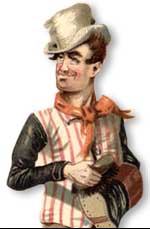
The popularity of The Pickwick Papers increased dramatically with the introduction, in chapter 10, of Pickwick's servant Samuel Weller, who councils his master with charming Cockney wisdom (Johnson, 1952, p. 148-149).
The colorful dialogue of Sam Weller and his father, Tony, in Pickwick Papers is peppered with what have become known as Wellerisms (Merriam-Webster Dictionary). Learn more and see a list of Wellerisms found in Pickwick Papers.
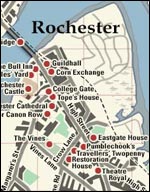
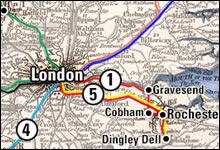
Many of the locations in Pickwick Papers are featured on my map of Charles Dickens' Rochester/Chatham.
Cursing in Dickens
As the stricter morals of the Victorian era replaced the ribaldry of the 18th-century, Dickens felt compelled to clean up his act. Instances of cursing in the novels dropped dramatically in his mid and late career. For example, below is a count of the full-use of the word "damn" (as opposed to just a capital D or d--d for damn or damned) in Dickens' works:
7 - Sketches by Boz
29 - Pickwick Papers
12 - Nicholas Nickleby
8 - Barnaby Rudge
1 - David Copperfield
3 - Bleak House
3 - Hard Times
3 - Little Dorrit
1 - Tale of Two Cities
3 - Great Expectations
1 - Our Mutual Friend
2 - Edwin Drood
A Father's Adwise...
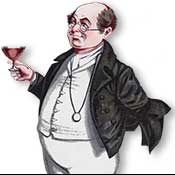
'I've only this here one little bit of adwice to give you. If ever you gets to up'ards o' fifty, and feels disposed to go a-marryin' anybody--no matter who--jist you shut yourself up in your own room, if you've got one, and pison yourself off hand. Hangin's wulgar, so don't you have nothin' to say to that. Pison yourself, Samivel, my boy, pison yourself, and you'll be glad on it arterwards.' -Tony Weller(Pickwick Papers, p. 315)
Charles Dickens' life during the serialization of The Pickwick Papers Mar 1836 - Oct 1837
Grieving for his beloved sister-in-law Dickens misses deadlines for the only time in his life. Monthly issues of Pickwick Papers and Oliver Twist are not published (Ackroyd, 1990, p. 228).
October 1837
Coaching Inns
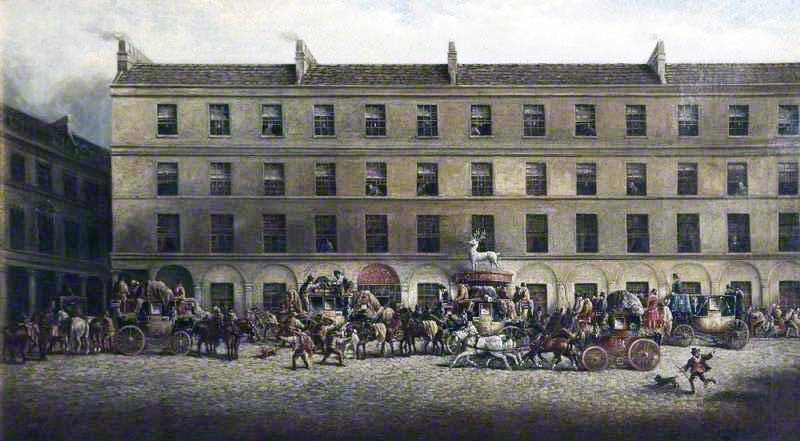
The Pickwick Papers, which Charles Dickens sets in the late 1820's, has Samuel Pickwick and his fellow travelers tour southern England by coach. This manner of travel began to disappear in the next decade as the railway covered Britain (Maskell, 1911, p. 85). Coaching inns mentioned in the novel with descriptions provided by B.W. Matz's The Inns and Taverns of Pickwick(Matz, 1921):
Charles Dickens first visited Bath in 1835 as a young reporter covering Lord John Russell’s tour of England and stayed at the Saracen’s Head on Broad Street (Matz, 1921, 175-176). In Bath Dickens would have been aware of the name Pickwick blazoned on the side of coaches owned by Moses Pickwick and based at the White Hart Hotel (Matz, 1921, 173-174). Thus, Dickens had the name of his protagonist and even mentions Moses in the book:
"The names is not only down on the vay-bill, Sir," replied Sam, "but they’ve painted vun on ’em up, on the door o’ the coach." As Sam spoke, he pointed to that part of the coach door on which the proprietor's name usually appears; and there sure enough, in gilt letters of a goodly size, was the magic name of PICKWICK!(Pickwick Papers, p. 493)
Dickens also has the Pickwickians stay at the White Hart Hotel while in Bath.
Jane Austin also uses the White Hart Hotel as a location in her novel Persuasion(Austen, 2003, 206).
Pickwickian Travels
Explore a map of the adventures of Samuel Pickwick and his friends.
Charles Dickens'
The Pickwick Papers
The Posthumous Papers of The Pickwick Club
The Pickwick Papers - Published in monthly parts Mar 1836 - Oct 1837
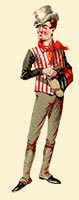
Samuel Pickwick by Joseph Clayton Clarke (Kyd) (1857-1937)
When artist Robert Seymour proposed to publishers Chapman and Hall a series of engravings featuring Cockney sporting life, with accompanying text published in monthly installments, they readily accepted and set about the task of finding a writer. The publishers were turned down by Charles Whitehead, a writer in their employ, and he recommended 24-year-old Charles Dickens to provide the text. Dickens accepted and argued successfully that the text should be foremost and the engravings should complement the story (Ackroyd, 1990, p. 177-178).
Seymour, an established artist but without recent success, was troubled with the direction the upstart writer was taking his project and with Dickens' suggestions of changes to the illustrations. On completion of the two engravings for the second monthly part of Pickwick, Seymour, who had been depressed about his finances, and about the direction his career was going, walked into his garden on the morning of April 20, and committed suicide (Schlicke, 1999, p. 523-525).
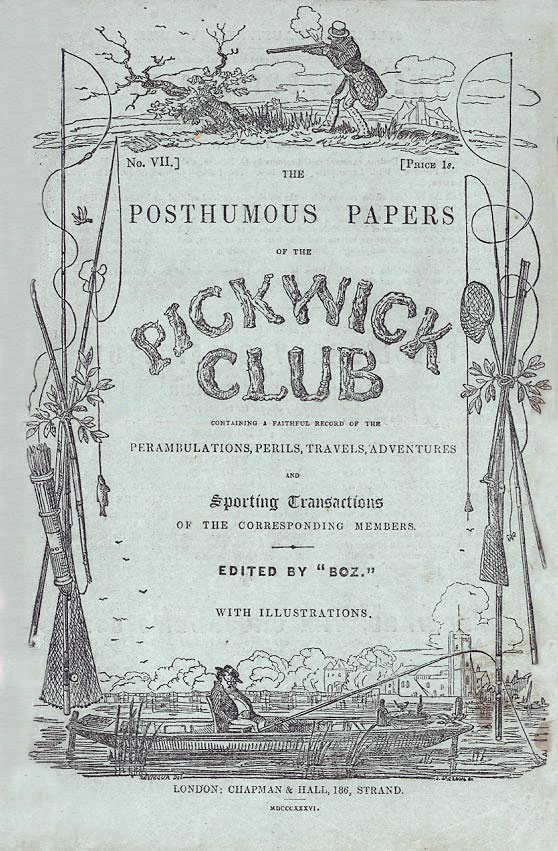
Chapman and Hall decided to continue with the project and, after trying artist R. W. Buss, whose work was deemed unsatisfactory, hired 20-year-old Hablot Knight Browne as illustrator. Browne, who took the nickname "Phiz" to complement Dickens' "Boz" (Johnson, 1952, p. 141-142), went on to illustrate Dickens' work for the next 23 years. The Pickwick Papers: Cover of the monthly numbers.Dickens took an active role in redesigning the project, the format was changed from 24 pages of text and four illustrations to 32 pages of text and two illustrations (Davis, 1999, p. 314). Dickens also abandoned the original concept of the "sporting club", which had been Seymour's idea (Dickens noted that despite spending a portion of his childhood in the country, that he was no sportsman (Schlicke, 1999, p. 444)) and began to tie the sketches together into a more cohesive novel.
The novel, a still somewhat loose collection of the adventures of Samuel Pickwick and his friends, was a huge success. Chapman and Hall printed only 1000 copies of the first monthly installment, at the end of serialization 40,000 copies were being printed (Schlicke, 1999, p. 449). Pickwick had taken Britain, and later the world, by storm and had successfully launched Charles Dickens to celebrity status.
When Mr Pickwick's landlady, Martha Bardell, brings a breach of promise suit against him and wins, the innocent Pickwick refuses to pay the damages, opting instead to be consigned to the Fleet debtor's prison.
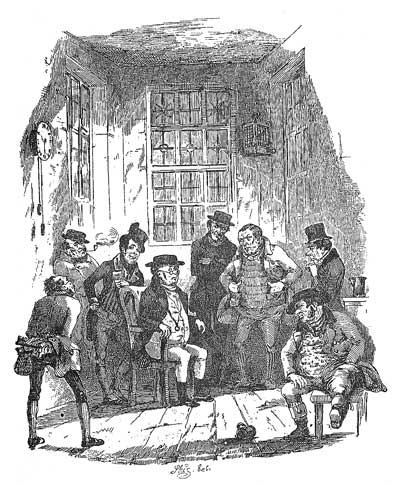
Mr Pickwick sitting for his portrait in the Fleet
Upon entering the Fleet he undergoes an initiation known as "sitting for your portrait" where all of the turnkeys (jailers) study Mr Pickwick's appearance to differentiate him from visitors to the prison who are allowed to come and go during the day.
Pickwick is appalled at conditions in the prison but is later told by a fellow prisoner that "money was, in the Fleet, just what money was out of it" (Pickwick Papers, p. 592) and is able to purchase a furnished private room where he remains for three months. Imprisonment for debt is a theme Charles Dickens uses frequently, his father having been imprisoned in the Marshalsea debtor's prison when Dickens was a child (Forster, 1899, v. 1, p. 22-39).
If you've read Dickens you have unquestionably come across the extraordinary curiosity of cockney characters interchanging V and W. Thus we have ven for when, vich for which, wery for very, and dewote for devote. Nowhere is this phenomenon more obvious than in the dialogue of Sam Weller and his father Tony in Pickwick Papers.
'What's your name, sir?' inquired the judge.
'Sam Weller, my Lord,' replied that gentleman.
'Do you spell it with a "V" or a "W"?' inquired the judge.
'That depends upon the taste and fancy of the speller, my Lord,' replied Sam; 'I never had occasion to spell it more than once or twice in my life, but I spells it with a "V." '
The Goblins Who Stole a SextonMr Wardle, at the Christmas Eve party at Dingley Dell, tells the story of Gabriel Grub, a morose and melancholy sexton and gravedigger in a village churchyard. Grub, an old curmudgeon at odds with the world, dreams he is visited by a host of goblins on Christmas Eve and changes his ways. The story is considered a precursor to A Christmas Carol.
Mr Pickwick Meets the Lady in Yellow Curl Papers
In one of the funniest episodes in the novel, Samuel Pickwick and his servant, Sam Weller, have traveled to Ipswich in search of the rascal Alfred Jingle, taking rooms in the Great White Horse Inn. Mr Pickwick is ready to retire for the night when he realizes he has left his watch on the dinner table downstairs and determines to go and get it.
Affiliate Links Disclosure
The Charles Dickens Page is a member of affiliate programs at Amazon and Zazzle. This means that there are links that take users to sites where products that we recommend are offered for sale. If purchases are made on these sites The Charles Dickens Page receives a small commission.


 Dickens felt compelled to clean up his act. Instances of cursing in the novels dropped dramatically in his mid and late career. For example, below is a count of the full-use of the word "damn" (as opposed to just a capital D or d--d for damn or damned) in Dickens' works:

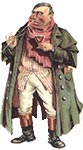 'I've only this here one little bit of adwice to give you. If ever you gets to up'ards o' fifty, and feels disposed to go a-marryin' anybody--no matter who--jist you shut yourself up in your own room, if you've got one, and pison yourself off hand. Hangin's wulgar, so don't you have nothin' to say to that. Pison yourself, Samivel, my boy, pison yourself, and you'll be glad on it arterwards.' -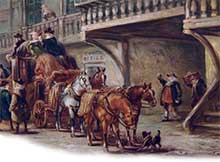

 If you've read Dickens you have unquestionably come across the extraordinary curiosity of cockney characters interchanging V and W. Thus we have ven for when, vich for which, wery for very, and dewote for devote. Nowhere is this phenomenon more obvious than in the dialogue of Sam Weller and his father Tony in Pickwick Papers.